
By Betsy Cullen
A question students often ask teachers is “Why do I hit the ball better on the range than on the golf course? and “Why can’t I bring my swing to the course?”
From my perspective, the big difference between a skilled golfer and a high handicapped golfer is what they emphasize as important in the preparation of their golf shot, as well as what they think to initiate the “trust and go” signal for striking their ball.
In the skilled golfer, I see a choreographed pre-shot routine that flows into a setup, that aligns club and body while the player engages herself with the shot and target, all of which is giving her confidence to “trust and go” for making the shot. In the higher handicap players I may see a pre-shot routine of moving into the ball, with an alignment of their club and body, but then a noticeable freeze, a disruption of flow suggesting swing thoughts are happening before “the trust and go” signal can be initiated.
Why swings thoughts? It could be because she thinks she should remember the swing corrections on the course because her shots are mostly good when she does this on the range; therefore, why shouldn’t she do it on the course?
Let me give you these two ideas. The golf range, in the beginning, is where you are correcting your swing faults and therefore is a place where you are playing swing, whereas a golf course is a place where you are playing golf shots to score with the swing you have at that moment. As Darryl Royal former University of Texas football coach would say, “You dance with the girl who brung ya!”
Another reason you may create lots of swing thoughts before you “trust and go” is that you don’t sense that a smooth take away will happen. Therefore, you feel the need to control and make it happen rather than being confident of a swinging motion that you can let happen and trust.
I will suggest there could be two reasons for being uncomfortable at address and both of them happen to be related to balance when addressing the ball.
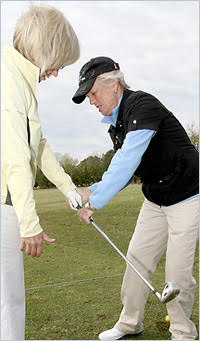 Even though you have the proper grip, your club may not feel balanced in your arms/hand/shoulders unit, preventing you from knowing where the weight, club face, and bottom of club are in your hands, By the way, when I talk about shoulders I mean the shoulder blades that glide and move independently of the torso. Shrug your shoulders up and down and back and forward and you will know what I mean. Yes, the shoulders/arms/hands unit holds the whole club lightly even though they extend to straighten and flex to bend throughout the swing. Both arms are straight at address. For a tip, pick up a club with the hands apart, like you would with a shovel. Take tension out of the wrists so that both hands will drop slightly, meaning not noticeably. Feel that balance and then keep it when moving your hands closer for a normal grip. Now lower the club to the ground behind the ball keeping that sensation of balance in the shoulders/arms/hands unit and sensing the bottom of the club on the ground. That is what I would take from the advice “let the club hang from the shoulders at address”.
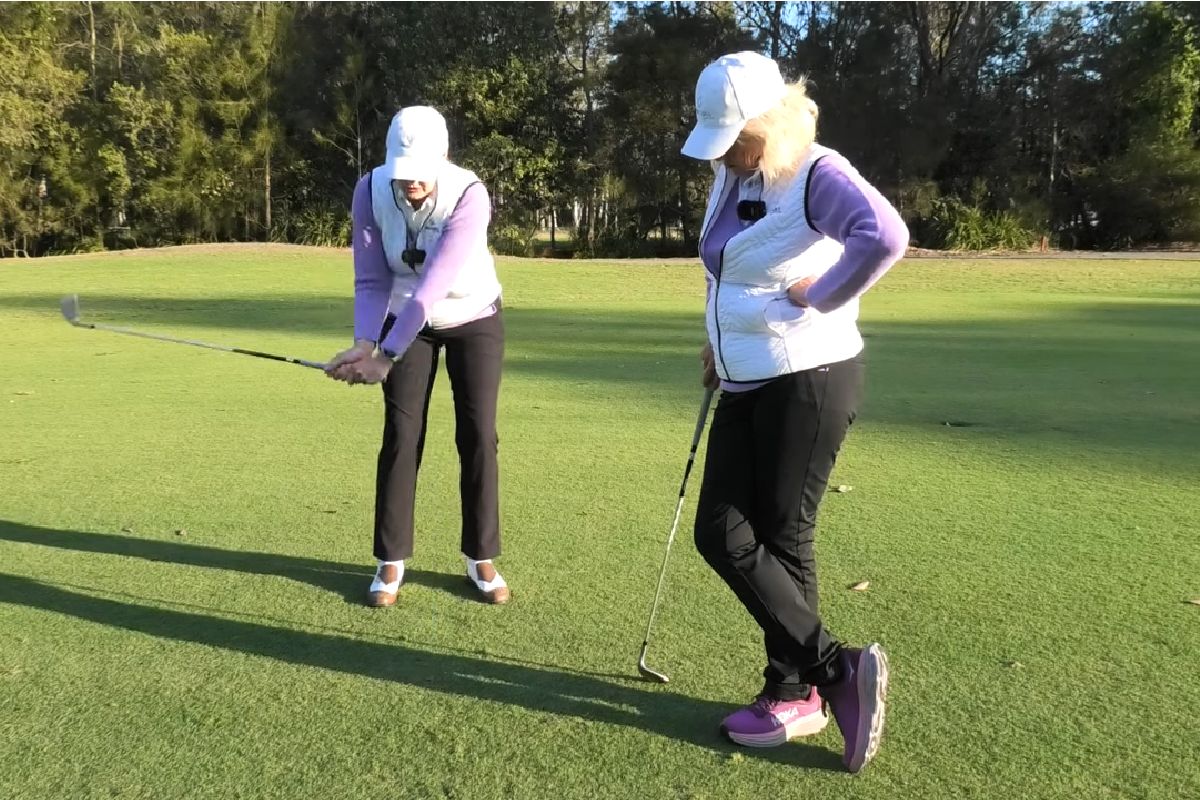
The second reason could be that your body does not feel balanced over your feet and legs. You sense you can’t, without thinking, synchronize the movement of your body weight from foot to foot with the “shift-turn pivot” of the back and through swing. For good balance remember you are balancing your seat and head over your feet and legs.
Think of tilting on a balance beam. You wouldn’t go headfirst. Try bending from the hips first, using the ball and socket joints. Your tailbone goes behind your heels and that’s why the head and top of the spine tilt forward. Start by standing tall, meaning with a relaxed neck and sensing the top of the head being gently directed upwards to the sky before tilting from the hips. This idea of gently stretching upwards lengthens the spine and opens the joints of ankles, knees and hips and can even cause the stomach muscles to tighten. The head staying up and relatively still is necessary for effective and balanced movement during the swing.
Now, what is the secret of “trust and go”? It can be as simple as knowing that after your preparation is done you trust your swinging motion so that you can clip the grass the ball is sitting on, or clip the tee the ball is sitting on. My former teacher Harvey Penick would give you a weed cutter to learn how to make a clip. He calls this taking “dead aim” I see the bottom of the club as the weed cutter with the face and its loft above it.
As you can tell, I truly believe that unreliable swings on the course come more from unreliable decisions and routines before you initiate the swing. Therefore, prepare to feel good over the ball as you relate to the target and shot, then commit to a swinging motion back and through with the intent to aim the bottom of the club in its arc. Let the ball get in the way of the club. Aiming is to accomplish that solid contact we all desire. In all practice swings with a ball position in mind, make it a habit to notice where your swing is bottoming out, and where you are clipping, (or brushing, or sweeping) even in a practice swing.
For fun check out the practice swings of others. Most people would miss the ball with their practice swing!
 A long-time student of the late Harvey Penick and three-time winner on the LPGA Tour, Betsy Cullen has been teaching golf for over 30 years. She had a very successful junior golf and amateur golf career prior to getting her education at the University of Oklahoma.
After 15 years and 3 victories on the LPGA Tour, Betsy began her remarkable teaching career. She is a two-time LPGA Central Section Teacher of the Year, a Golf Digest “Top 50 Women Teachers in America”” selection, an LPGA “Top 50 Teacher”, one of GOLF Magazine’s “Top Teachers”, a Golf For Women Magazine “Top 50” Teacher, and one of Golf Digest Magazine’s “Top Regional Teachers”.
Betsy received the prestigious LPGA “Ellen Griffin Rolex Award” and was inducted into the Oklahoma Women’s Golf Hall of Fame in 2008.
Betsy Cullen can be reached at 713-858-5546 or via e-mail at cncgolf@ix.netcom.com.
You can also follow Betsy Cullen online on Facebook or Twitter.
*Feature image – David Burness Kinetic Images






















![Ready to get your game in shape] popup](https://womensgolf.com/wp-content/uploads/2025/12/Ready-to-get-your-game-in-shape-popup.jpg)