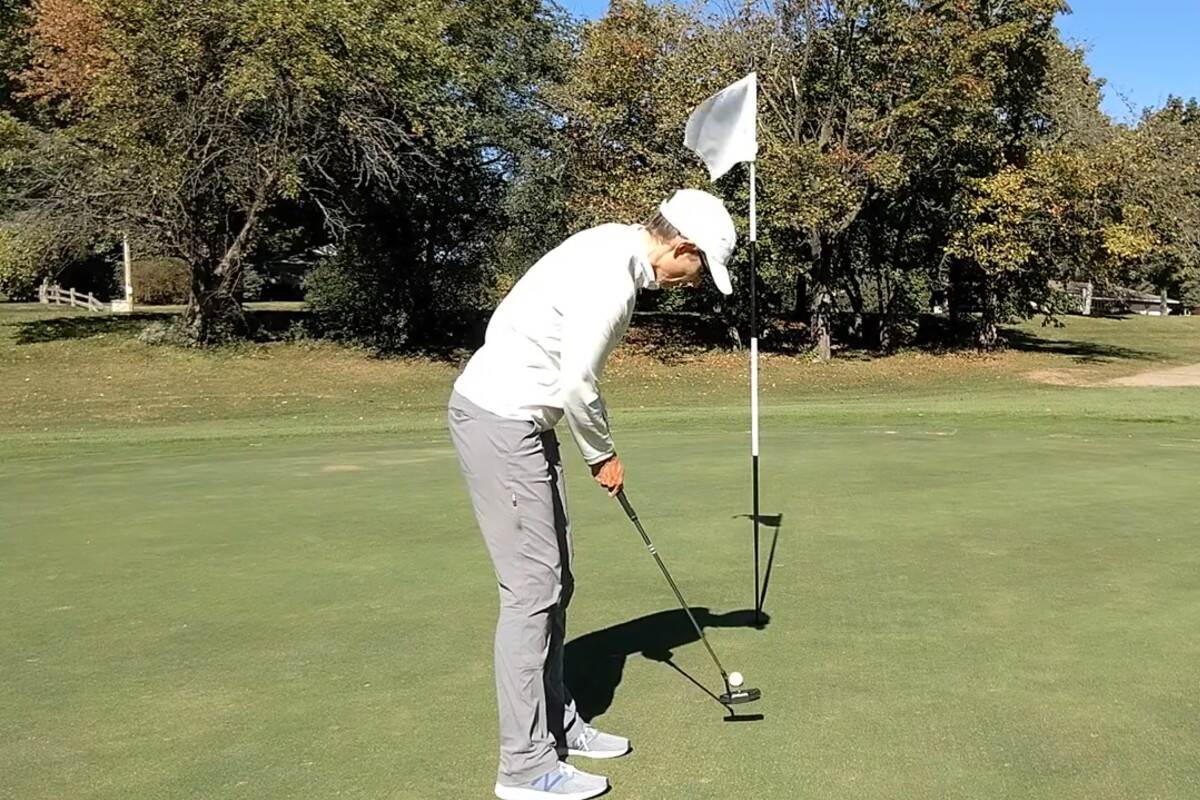
Watch the quiet eye video on Sue’s YouTube Account
Show/Hide Notes and Q&A
Align for Success: Consistency starts with a visual guide. If your ball has a manufactured line or a personal mark, use it. Take the time to align that mark directly with your target line into the hole. This eliminates guesswork once you are standing over the ball, allowing you to trust your aim and focus entirely on the stroke.
Simplify Your Aim: On short putts (around four feet), avoid overcomplicating the break. Unless you are on an incredibly severe slope, your aim point should remain within the width of the hole. Aiming “outside the cup” on a short putt often leads to unnecessary misses if the speed isn’t perfect.
Speed and “Quiet Eye”: Speed is just as vital on a four-foot putt as it is on a forty-footer. If you hit the ball too hard, you risk lipping out or leaving yourself a difficult return putt. Ideally, the ball should “die” just over the front lip. To achieve this, use the “Quiet Eye” technique: pick a specific spot or dimple on the ball and maintain steady focus on it from setup until after impact.
Listen for the Drop: One of the biggest causes of pulled putts is looking up too early to see if the ball went in. This movement causes your shoulders to turn, which pulls the putter head off-line. Instead, keep your eyes looking down at the grass where the ball was until you actually hear the ball drop into the cup.
Questions and Answers
Q: Why shouldn’t I aim outside the hole on a breaking short putt? A: On a four-foot putt, the ball is traveling at its highest relative speed. This means the break has less time to take effect. Aiming inside the hole gives you a much larger margin for error regarding speed.
Q: How does the “Quiet Eye” help my stroke? A: Focusing on a single spot prevents “eye wandering,” which is often a physical symptom of a wandering mind. It keeps your head still and your concentration locked on the point of contact.
Q: What if I can’t hear the ball drop (e.g., windy days or noisy courses)? A: In those cases, use a slow count. Keep your head down for a full “one-two” count after impact before allowing yourself to look toward the hole.






![Ready to get your game in shape] popup](https://womensgolf.com/wp-content/uploads/2025/12/Ready-to-get-your-game-in-shape-popup.jpg)